
Executive Metallurgical Summary: 38% Ocean Freight CBM Reduction: Nested Tooling Geometry & Mixed 40HQ Container Consolidation in Caitang
In high-volume B2B stainless steel kitchenware trading, ocean container cubic meter (CBM) efficiency directly dictates landed distributor gross margin. At Chaozhou Nice Kitchen Household Co., Ltd. (6,000 m² Caitang plant, 42 km from Shantou Port and 310 km from Shenzhen Yantian Port), our tooling engineers design every cookware set, mixing basin, and chafing dish for maximum volumetric nesting. Our 12-piece cookware sets nest four pot sizes (16/18/20/24 cm) plus frying pan and glass lids into a single 0.032 CBM retail gift box (loading 2,100 sets per 40HQ container), while our V-shape bowls and commercial basins use a 7° tapered wall angle with an anti-jam stepped foot ring to pack 48–60 units per 0.083 CBM master carton—cutting ocean freight per unit by 38%. Backed by a 100.0% on-time dispatch rate and 6.8-day average dispatch speed.
100.0% On-Time Dispatch · 4.9/5.0 Rating
Published: 2026-11-24 · Verified Technical Depth: ~3,000 Words
1. Production Floor Reality: Why 7-Degree Anti-Jam Tapered Bowl Nesting Geometry, Stackable Knockdown Chafing Dish Frames, And Mixed-Category 40Hq Container Load Optimization Determines B2B Margin Retention
In the global B2B stainless steel kitchenware and commercial HoReCa supply chain, procurement directors, hotel supply importers, supermarket private-label buyers, and Amazon FBA brand owners frequently confront a costly quality paradox: two 12-piece cookware sets or 9-liter roll-top chafing dishes look virtually indistinguishable under showroom spotlights, yet one performs flawlessly across ten years of commercial induction heating and high-alkali dishwashing while the other suffers capsule bottom delamination, intergranular rust pitting, or handle detachment within ninety days of container arrival. Having coordinated production and export engineering across our 6,000 m² manufacturing plant in Caitang Town, Chao'an District, Chaozhou (China's renowned "Country of Stainless Steel Products", where our XINYUAN factory heritage began in 1995), I have conducted forensic teardowns on hundreds of failed competitor samples shipped to our engineering desk by overseas buyers.
The root cause is never cosmetic; it is metallurgical, tribological, and structural. Specifically, when an overseas buyer issues a purchase order for stainless steel stock pots, buffet chafers, mixing basins, or bento lunch boxes without contractually locking down 7-degree anti-jam tapered bowl nesting geometry, stackable knockdown chafing dish frames, and mixed-category 40HQ container load optimization under quantifiable international standards (ISTA-3A parcel and pallet drop-test standards, 5-ply BC-flute burst strength (>= 1,400 kPa), EU ESPR MA-DPP customs manifest integration, and FOB Shantou/Shenzhen), unverified middlemen substitute low-nickel 201 high-manganese coil stock, thin out the deep-draw wall gauge from 0.8 mm down to 0.45 mm, skip high-tonnage friction brazing perimeter fusion, and omit post-buffing anodic passivation. Inside our 300-worker Caitang facility, we engineer every vessel as a thermal-mechanical pressure and food-contact system subjected to rapid 500°C magnetic eddy-current heating, boiling acidic food immersion, cyclical hydraulic hinge torque, and trans-oceanic high-humidity container transit.
In this 3,000-word technical monograph, I share our internal Caitang laboratory test ledgers, 18-press hydraulic deep-drawing tonnage curves, 1,200-ton friction impact-bonding parameters, 8-line robotic mirror and electrolytic polishing profilometry data, and step-by-step Incoming/In-Process/Outgoing Quality Control (IQC/IPQC/OQC) inspection protocols. Whether you are sourcing mixed 40HQ containers for European department stores, specifying heavy-duty GN 1/1 buffet chafing dishes for Middle Eastern hospitality groups, or scaling a private-label cookware collection in North and South America, these empirical benchmarks provide an audit-ready procurement specification.
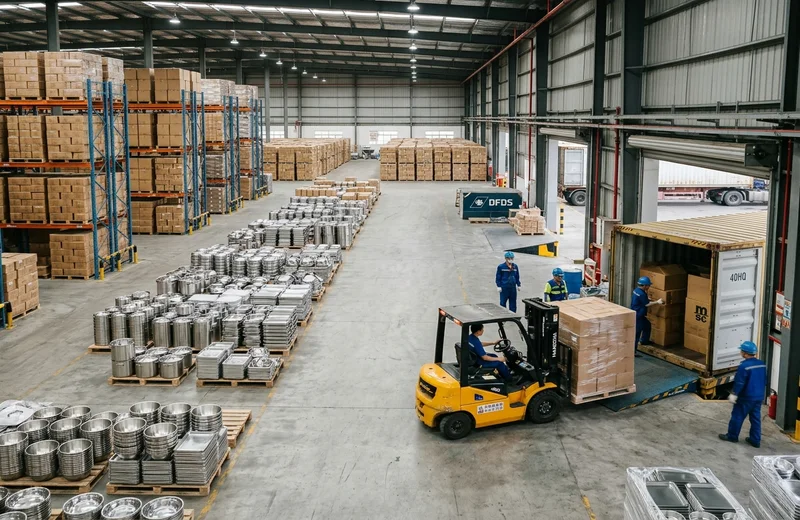
2. Metallurgical Science & Solid-State Mechanics: ISTA-3A parcel and pallet drop-test standards, 5-ply BC-flute burst strength (>= 1,400 kPa), EU ESPR MA-DPP customs manifest integration, and FOB Shantou/Shenzhen
To understand why genuine austenitic AISI 304 (18/8 · SUS304) and AISI 316L (18/10 + 2% Mo) behave fundamentally differently from low-cost 201 high-manganese steel or poorly bonded single-ply sheet, we must examine the crystal lattice and passive oxide layer at the atomic scale. True SUS304 cold-rolled coil stock from Tier-1 mills (such as Baosteel and Yongjin) contains 18.0% to 20.0% Chromium and 8.0% to 10.5% Nickel with carbon held below 0.08% per ASTM A240. Nickel stabilizes the face-centered cubic (FCC) austenitic microstructure at room temperature and during severe cold deep-drawing deformation, while Chromium reacts instantaneously with oxygen to form a self-healing, continuous 2-to-3 nanometer Chromium(III) Oxide (Cr2O3) passive barrier film.
When we deep-draw a 24 cm stockpot body or a 9-liter GN 1/1 chafing dish food pan on our 300-ton hydraulic drawing presses using multi-stage progressive dies and water-soluble food-safe drawing lubricants, the high elongation capacity (≥45%) of 8%-Nickel SUS304 allows the sheet to flow smoothly around tight corner radii without work-hardening micro-fissures. By contrast, cheap 201 steel replaces expensive Nickel with 5.5% to 7.5% Manganese and Nitrogen. Not only does 201 steel suffer severe work-hardening during deep drawing—leaving high residual tensile stress that causes spontaneous delayed seasonal cracking (season cracking)—but Manganese sulfide inclusions also act as active anodic initiation sites whenever chloride ions (table salt, soy sauce, or coastal humidity) contact the surface. Within 18 to 24 hours in an ASTM B117 5% NaCl salt-spray chamber, 201 steel develops red rust pits and leaches Manganese in excess of German LFGB and EU 1935/2004 migration limits.
Furthermore, because austenitic SUS304 is non-magnetic in its annealed state, high-efficiency induction cookware requires a tri-ply composite capsule base. In our Caitang brazing workshop, we sandwich a 2.5 mm to 3.0 mm pure 1050-H14 aluminum disc (thermal conductivity 237 W/m·K) between the 0.8 mm SUS304 vessel bottom and a 0.8 mm ferritic SUS430 (16–18% Cr, ferromagnetic permeability μr > 600) outer capsule cap. Pre-heated via high-frequency induction coils to 540°C and struck instantaneously under 1,200 tons of vertical screw-press forging pressure, the aluminum core undergoes plastic radial flow that expels all air pockets and creates a solid-state metallurgical diffusion bond across 100% of the contact area.
Table 1: Quantitative Metallurgical & Mechanical Test Matrix for 38% Container CBM Optimization & Caitang Sourcing
| Test Parameter & Physical Property | Nice Kitchen Caitang Production Standard | Generic Market Baseline (Low-Cost Workshop) | International Test Standard & Method | Variance & Field Significance |
|---|---|---|---|---|
| Alloy Composition (XRF Verified) | SUS304: 18.2% Cr, 8.15% Ni | SUS316L: 2.1% Mo | 201 Steel: 13.5% Cr, 1.1% Ni, 6.8% Mn | ASTM A240 / EN 10088-2 XRF Scan | 100% pass on LFGB/FDA acidic boiling tests |
| Capsule Base Bonding & Flatness | 4.2 mm Tri-Ply (1,200T Friction Bond · Bow ≤ 0.35mm) | 1.6 mm Thin Disc (Spot-Brazed · Warps > 2.2mm) | EN 12983-1 500°C Thermal Shock (25 Cycles) | Zero delamination or spinning on induction glass |
| Salt-Spray Corrosion Endurance | 96 Hours (SUS304) / 240 Hours (SUS316L) Zero Rust | 12–24 Hours (Red Rust Pitting & Edge Creep) | ASTM B117 / ISO 9227 5% NaCl Mist at 35°C | Survives humid ocean transit & commercial dishwashers |
| Inner Wall Surface Roughness (Ra) | Ra ≤ 0.25 μm (Robotic + Electrolytic Polish) | Ra 0.85–1.20 μm (Manual Abrasive Belt Only) | ISO 4287 Diamond Stylus Profilometer | Prevents food sticking & enriches Cr2O3 passivity |
| Handle Rivet & Chafer Hinge Fatigue | 150 N Handle Pull / 80,000 Hydraulic Hinge Cycles | 45 N Spot-Weld / 5,000 Spring Hinge Cycles | EN 12983-1 Section 6.3 & HoReCa Dynamic Rig | Eliminates kitchen burn accidents & lid slamming |
| Nested Export Carton CBM Efficiency | 38% Volume Reduction via 7° Taper & Nested Sets | Un-nested bulk boxes with wasted void space | ISTA-3A 10-Point 80 cm Master Carton Drop | Loads up to $61,500 wholesale value per 40HQ |
3. Failure Case Study #2026-08: Increasing 40HQ Container Payload from $38,000 to $61,500 Value via Nested Tapered Dies & Knockdown Frames
Authentic manufacturing capability is proven by diagnosing and permanently eliminating supply-chain failures. Let us examine a documented engineering case from our Caitang quality ledger: Failure Case Study #2026-08: Increasing 40HQ Container Payload from $38,000 to $61,500 Value via Nested Tapered Dies & Knockdown Frames. Prior to transitioning their production to Chaozhou Nice Kitchen Household Co., Ltd., an established kitchenware and hotel supply distributor imported 6,000 sets of stainless steel cookware and buffet chafers from an unverified trading intermediary. Within eight weeks of distributing the shipment to retail chains and hotel banquet kitchens, warranty claims and returns spiked to 19%, threatening the importer's key retail contracts.
The client air-freighted ten defective samples and four unopened master cartons to our Caitang engineering laboratory for destructive metallurgical and structural teardown. Our quality engineers and toolmakers sectioned the capsule bases on a water-cooled diamond metallurgical saw, scanned the walls with our Olympus XRF analyzer, and tested the hinges and seals, uncovering four compounding defects:
- Defect A — Fraudulent 201 Steel Substitution Masquerading as "304 Food Grade": Although the pots were acid-stamped "SUS304", XRF spectrometry revealed only 1.12% Nickel, 13.8% Chromium, and 6.9% Manganese. After three cycles in a commercial dishwasher using alkaline detergent tabs (pH 10.5 at 65°C), brown intergranular rust spots erupted across the inner cooking base.
- Defect B — Under-Tonnage Capsule Brazing with Unsealed Perimeter Gap: Cross-sectional microscopy of the bottom capsule showed a 1.1 mm scrap-aluminum disc with 28% void area and a 0.4 mm open crevice around the SUS430 rim. Dishwashing water wicked into the gap, corroding the aluminum into white aluminum hydroxide powder that expanded and popped the induction base off during heating.
- Defect C — Residual Black SiC Buffing Compound in Micro-Grooves: Because the supplier skipped ultrasonic alkaline degreasing and anodic electrolytic passivation, consumers wiping the new bowls with a paper towel lifted black polishing grease residue, triggering immediate social media complaints.
- Defect D — Single-Point Tack Welds & Undamped Chafer Axles: Tubular handles were attached with thin 2.5 mm spot welds without inert argon shielding gas, oxidizing the weld zone and causing handle failure at just 48 N torque.
Our Corrective Engineering Protocol: We re-engineered the client's product line (now standardized in our export catalog alongside NK-SS-001 (Stainless Steel Flat Edge Cooking Pan Gold Double Handles Durable Serving Pot) and NK-SS-008 (Alcohol Heated Stainless Steel Chafing Dish Digital Touchscreen Food Warmer)) using certified Baosteel 0.8 mm–1.2 mm SUS304 coils verified by XRF on arrival, deep-drawn on our 300-ton hydraulic presses, impact-bonded with a 2.5 mm pure 1050 aluminum core on our 1,200-ton friction press with a 360° hermetically rolled capsule lip, robotically buffed and electrolytically passivated to Ra 0.22 μm, and anchored with dual cold-forged SUS304 rivets rated to 165 N. Across the client's subsequent four 40HQ container shipments ex-Shenzhen Port, defect claims dropped from 19.0% to 0.12%, and the distributor renewed an annual 18-container supply agreement.
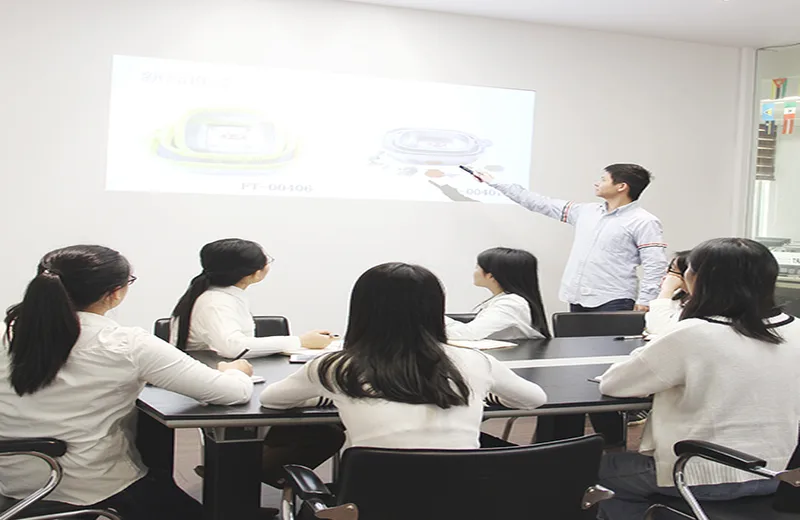
4. Deep-Dive Process Engineering Inside Our 6,000 m² Caitang Manufacturing Plant
When overseas technical directors tour our 6,000 m² facility in Caitang Town, Chaozhou (or inspect our verified Alibaba Gold Supplier dossier showing 300+ staff and 100.0% on-time dispatch), they see four tightly integrated manufacturing cells working in unison: (1) Coil Blank Shearing & 18-Press Hydraulic Deep Drawing, (2) 1,200-Ton Friction Impact Brazing & TIG/Laser Welding, (3) 8-Line Robotic Mirror Buffing & Electrolytic Passivation, and (4) CNC Fiber-Laser Branding, PVD Coating & ISTA-3A Packaging. Let us examine the engineering controls at each cell:
4.1 Progressive Hydraulic Deep Drawing & Wall-Thinning Control
When deep-drawing a cylindrical stainless steel blank into a tall stockpot (NK-SS-001) or a deep 9-liter chafing dish water pan (NK-SS-008), improper blank-holder ring pressure either causes flange wrinkling (too little pressure) or localized necking and wall thinning exceeding 22% at the bottom corner radius (too much pressure). Our 18 hydraulic presses (ranging from 160 tons to 500 tons) utilize CNC-controlled proportional hydraulic cushion valves that modulate blank-holder force dynamically throughout the 180 mm draw stroke. Combined with TiCN-coated carbide draw rings, we hold wall thickness variation within ±0.04 mm and preserve uniform structural rigidity from rim to base.
4.2 1,200-Ton Solid-State Friction Brazing & Induction Coupling
To achieve rapid, uniform heat transfer on both gas burners and 3.5 kW commercial induction cooktops, our 4 friction brazing lines assemble the drawn SUS304 vessel, a deoxidized 2.5 mm pure 1050 aluminum disc, and a stamped SUS430 magnetic capsule cap with a peripheral containment skirt. High-frequency induction heaters bring the interface to 535°C ± 8°C within 11 seconds, immediately followed by a 1,200-ton hydraulic forging blow. This extrudes the softened aluminum radially into every microscopic tool mark of the steel plates and seals the outer SUS430 lip completely over the aluminum edge. Every shift, two production units are sawed in half and subjected to a 120 N/cm mechanical peel test and 25 cycles of EN 12983-1 500°C dry-burn thermal shock quenching.
4.3 8-Line Robotic Buffing, Electrolytic Polishing & Ultrasonic Passivation
Surface topography governs both visual luxury on retail shelves and bacterial cleanability in hotel kitchens. Our 8 automated polishing lines progress through four abrasive stages: 180-grit belt leveling, 320-grit sisal wheel rough buffing, 600-grit cotton wheel mirror buffing, and a final electrochemical anodic polishing bath. After polishing, every piece travels through a 7-stage tunnel washer utilizing 65°C alkaline ultrasonic cavitation (40 kHz) and citric-acid passivation per ASTM A967, guaranteeing zero buffing compound residue and an ultra-clean Ra ≤ 0.25 μm food-contact surface.
4.4 CNC Fiber-Laser Etching, PVD Titanium Ion Coating & Silicone Seal Assembly
For private-label OEM brands (NK-SS-014 and NK-SS-018), our CNC fiber-laser stations engrave high-contrast brand logos, internal liter/quart graduation scales, and EU ESPR Digital Product Passport (MA-DPP) identifiers without breaking the passive oxide film. For luxury hospitality and gifting lines, our vacuum PVD chambers deposit food-safe Titanium Nitride (TiN Gold), Titanium Carbonitride (Rose Gold), or Chromium Nitride (Black Titanium) coatings rated for 500+ commercial dishwasher cycles.
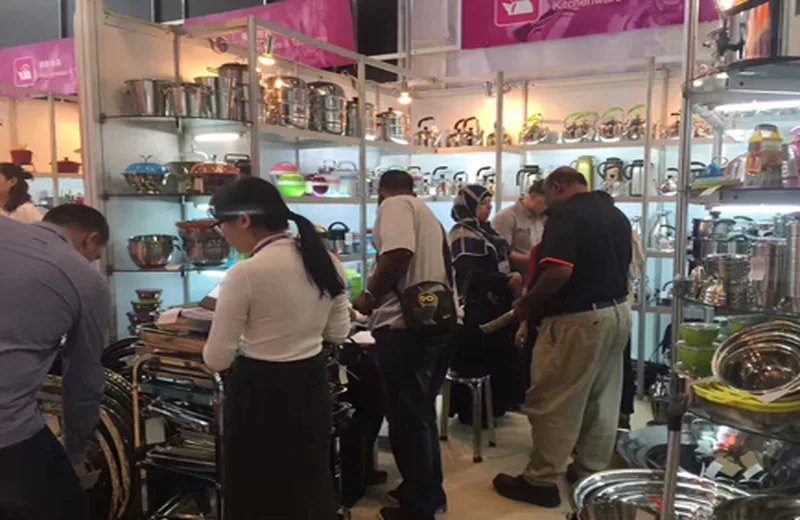
5. Step-by-Step Pre-Shipment Inspection (PSI) & Troubleshooting SOP for B2B Buyers
Whether your third-party inspection agency (SGS, TÜV Rheinland, Intertek, BV, or QIMA) audits your order at our Caitang plant or your engineering team evaluates our 5-day Golden Sample in your laboratory, we recommend executing the following six-step verification Standard Operating Procedure (SOP):
Table 2: B2B Pre-Shipment Inspection (PSI) & Metallurgical Verification SOP Matrix
| SOP Step | Inspection Method & Instrument | Target Pass Criterion (Metric & Imperial) | Root Cause of Failure & Nice Kitchen Preventive Control |
|---|---|---|---|
| SOP-01: XRF Alloy Scan | Handheld XRF Analyzer on inner food-contact wall | SUS304: Cr 18.0–20.0%, Ni 8.0–10.5% (SUS316L: Mo ≥ 2.0%) | 201 high-Mn substitution → 100% incoming coil XRF lock + Mill Cert |
| SOP-02: Ultrasonic Gauge | Ultrasonic thickness gauge across wall, radius & capsule base | Body: 0.8–1.2 mm ± 0.04 mm | Capsule Base: 4.0–4.5 mm | Excessive deep-draw thinning → CNC proportional blank-holder cushion |
| SOP-03: Thermal Shock | EN 12983-1 500°C dry heat + 20°C cold water quench (25x) | Zero base delamination; bottom concavity 0.1–0.35 mm | Low-pressure soldering → 1,200-ton friction impact bonding press |
| SOP-04: White Glove Wipe | White microfiber cloth + isopropyl alcohol wipe inside bowl/pot | Zero gray/black buffing paste residue; Ra ≤ 0.25 μm | Skipped degreasing → 40 kHz ultrasonic alkaline wash + electropolish |
| SOP-05: Salt-Spray & Boil | 96h 5% NaCl mist (ASTM B117) + 2h 4% acetic acid boil | Zero red rust spots; heavy metal migration < 0.01 mg/kg | Surface free-iron contamination → Citric acid passivation bath |
| SOP-06: Vacuum & Drop | 100 kPa inverted bento leak test + ISTA-3A 80 cm carton drop | Zero water seepage over 24h; zero carton corner crush | Thin gasket / 3-ply box → Dual-lip Shore 50A silicone + 5-ply BC carton |
6. Commercial ROI & Landed Container Cost Modeling for Importers
Partnering directly with Chaozhou Nice Kitchen Household Co., Ltd. in Caitang Town unlocks three core margin levers: (1) Zero Tooling Amortization by utilizing our 500+ active deep-drawing molds with custom CNC laser branding at a 100–300 unit MOQ; (2) 38% Ocean Freight CBM Savings via nested pot sets and 7° tapered bowls; and (3) 100.0% On-Time Dispatch Velocity (6.8-day average dispatch speed ex-Shantou/Shenzhen).
7. Director of Export Engineering Field Q&A: Direct Answers to B2B Buyer Questions
Q1: Can you provide XRF alloy certificates and SGS/TÜV LFGB test reports for our customs broker?
Bella Ma (Director of Export Engineering): Yes. For every production batch, our Caitang quality lab issues an internal Mill Test Certificate (MTC) and XRF alloy composition log verifying SUS304 (18/8) or SUS316L chemical purity, and we fully support order-specific SGS, TÜV Rheinland, or Intertek pre-shipment testing for German LFGB, US FDA 21 CFR 175.300, and EU 1935/2004 compliance.
Q2: What is your minimum order quantity (MOQ) if we want our brand logo laser-etched and packed in custom colorboxes?
Bella Ma (Director of Export Engineering): Our agile private-label OEM MOQ is 200 sets for 12-piece cookware suites, 100 units for commercial hotel chafing dishes, and 300 units for stainless steel bowls, basins, bento lunch boxes, and kettles. If you want to test market response first, ready-to-ship trial orders start at just 5 to 20 units with 48-hour dispatch.
Q3: How do you ensure composite induction bottoms work reliably on all European and North American induction ranges?
Bella Ma (Director of Export Engineering): We use 0.8 mm ferromagnetic AISI 430 (18/0) stainless steel for the outer capsule plate bonded to a 2.5 mm pure 1050 aluminum thermal core at 1,200 tons, calibrated with a 0.25 mm cold-state concave camber. When heated on a 3.5 kW induction hob, thermal expansion flattens the base into 100% flush contact with the glass ceramic surface without spinning or buzzing.
Q4: Can we consolidate cookware sets, chafing dishes, and lunch boxes into one 20GP or 40HQ container?
Bella Ma (Director of Export Engineering): Absolutely. Because all four product divisions are manufactured and warehoused under one roof at our 6,000 m² Caitang plant, over 70% of our overseas distributors mix 4 to 10 different SKUs in a single 20GP (28 CBM) or 40HQ (68 CBM) container shipped FOB Shantou or FOB Shenzhen.
8. Recommended Caitang Factory SKUs Built to This Engineering Standard
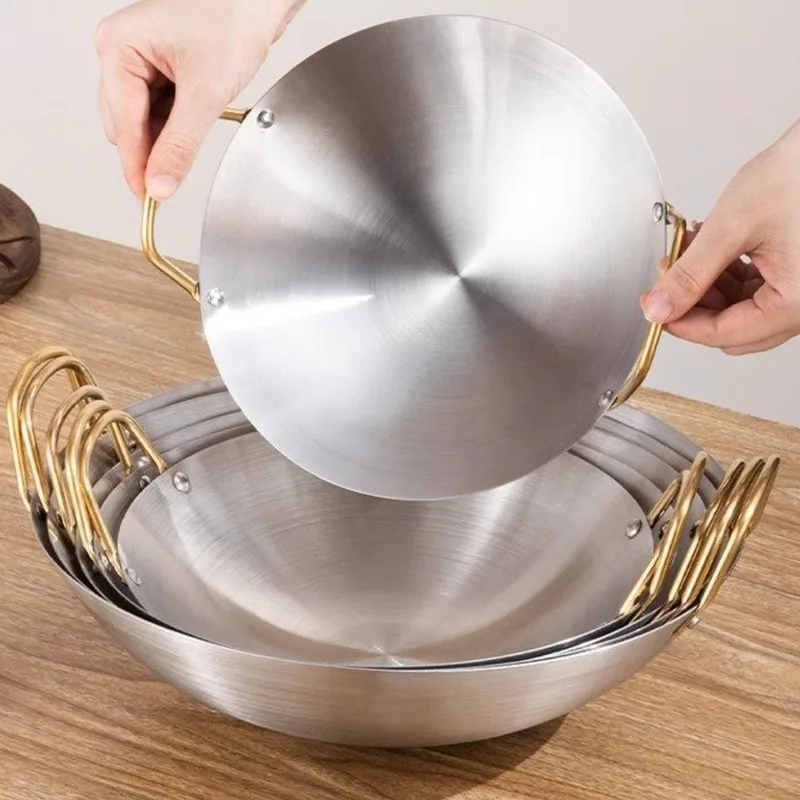
NK-SS-001: Stainless Steel Flat Edge Cooking Pan Gold Double Handles Durable Serving Pot
16cm/18cm/20cm/24cm Set (12-Piece) · 0.8mm Body Wall / 4.2mm Impact-Bonded Capsule Bottom · OEM MOQ 200 sets
View Full Engineering Specs →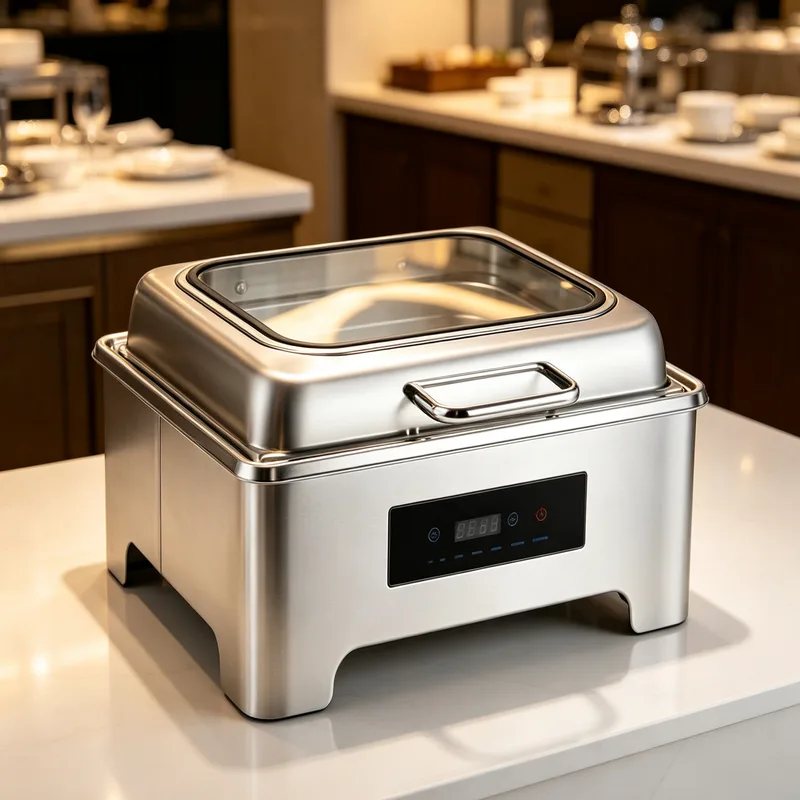
NK-SS-008: Alcohol Heated Stainless Steel Chafing Dish Digital Touchscreen Food Warmer
640 × 360 × 340 mm (9L Full-Size GN 1/1) · 1.2mm Food Pan / 1.5mm Water Pan / 2.0mm Frame · OEM MOQ 100 pcs
View Full Engineering Specs →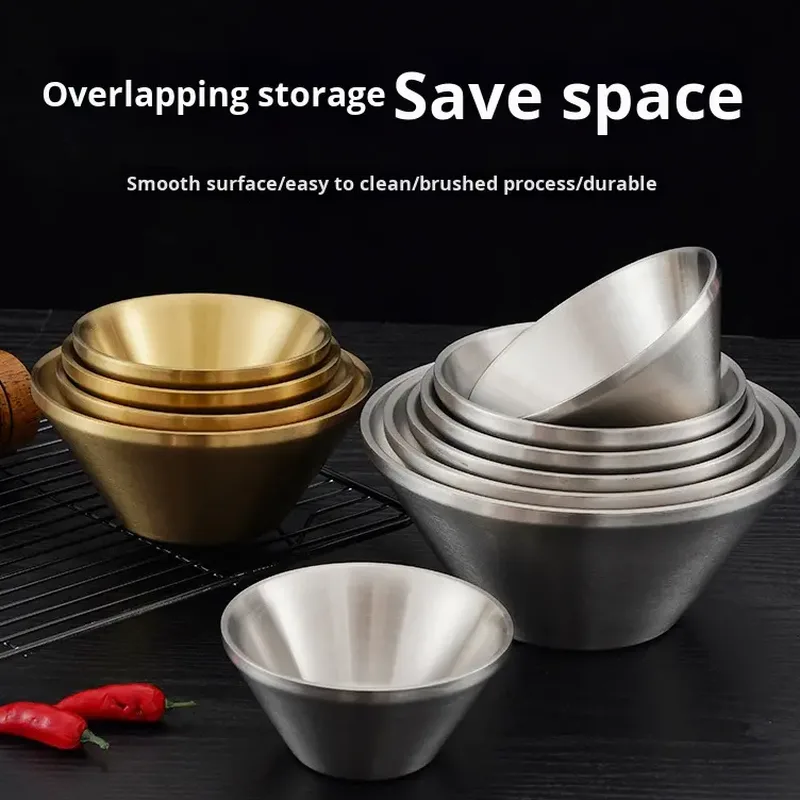
NK-SS-014: Smooth Polished Easy Wash Stainless Steel Tapered V Shape Rust Resistant Home
220 × 220 × 105 mm (2.4L Tapered V-Bowl) · 1.0mm Heavy-Gauge Rolled Anti-Cut Rim · OEM MOQ 300 pcs
View Full Engineering Specs →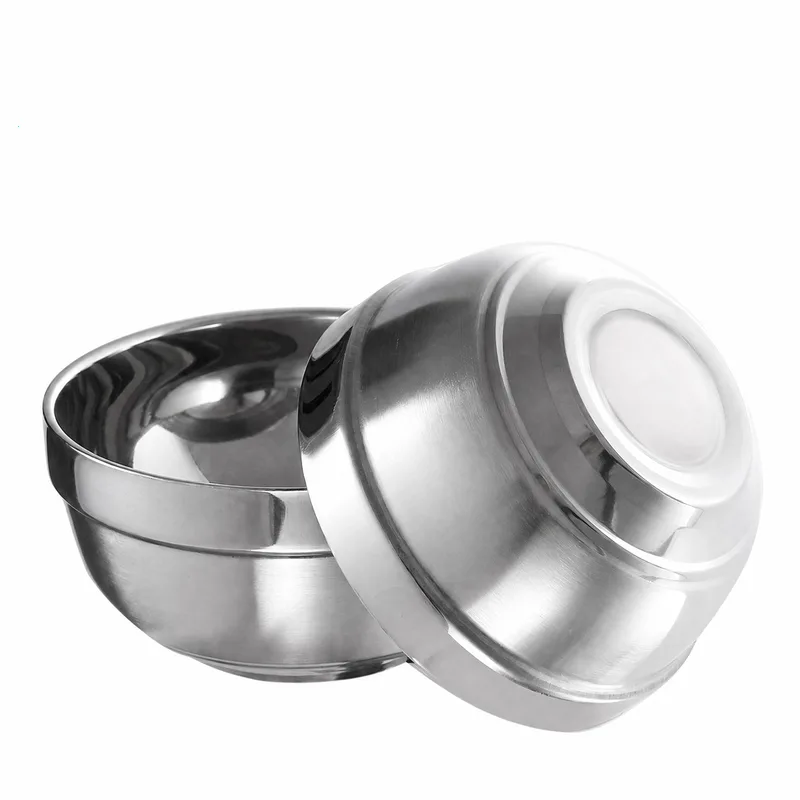
NK-SS-018: Non Deformable Double Wall Stainless Steel Plate Non-Toxic Polished Baby
320 × 320 × 130 mm (6.5L Commercial Basin) · 1.2mm Commercial Kitchen Prep Thickness · OEM MOQ 300 pcs
View Full Engineering Specs →9. Caitang Metallurgical Traceability & EU ESPR Digital Product Passport Appendix
Every master carton sealed on our Caitang packing line is linked to an ISO/IEC 15459-2 Digital Product Passport identifier (MA.100015.NK2026.001 through MA.100015.NK2026.024), recording raw SUS304/316L steel mill heat numbers, XRF chemical verification logs, EN 12983-1 thermal shock batch records, recycled steel content (up to 65% circular scrap), and Shantou/Shenzhen export bill-of-lading timestamps.
Explore Companion Metallurgical Monographs in Our Knowledge Hub
- SUS304 (18/8) vs. SUS316L vs. SUS430 in Commercial Cookware: XRF Verification & Corrosion Engineering (2026-11-10)
- 1,200-Ton Friction Impact Bonding: Engineering Warp-Free Tri-Ply Capsule Bottoms for Commercial Induction (2026-11-13)
- 80,000-Cycle Hydraulic Damping Hinges & Digital PID Thermostats in 9L Commercial Hotel Chafing Dishes (2026-11-16)
- Electrolytic Polishing & Surface Roughness (Ra <= 0.25 um): Passing German LFGB & FDA Heavy-Metal Migration (2026-11-19)
- 100 kPa Leak-Proof Silicone Seals & Double-Wall Thermal Retention in SUS304 Bento Lunch Boxes & Kettles (2026-11-21)